


Why Hiring a Licensed Heating Contractor Matters in the High Desert
When you’re searching for a licensed heating contractor in Joshua Tree CA, you need someone who understands the unique demands of high desert winters and holds the proper credentials to work safely in your home. A licensed contractor protects you from substandard work, ensures compliance with local building codes, and provides recourse if something goes wrong.
Quick Answer: Finding a Licensed Heating Contractor in Joshua Tree, CA
- Verify the license – Use the CSLB License Check tool to confirm active C-20 classification
- Check insurance – Confirm workers’ compensation and liability coverage
- Read reviews – Look for customer feedback from other Morongo Basin residents
- Ask for references – Request contact information from recent local projects
- Get written estimates – Compare detailed quotes from multiple licensed contractors
Joshua Tree’s desert climate creates specific heating challenges. Winter temperatures can drop below freezing at night, putting stress on heating systems that sit idle for much of the year. Dust and sand infiltrate equipment, and the dry air affects system efficiency. You need a contractor who knows these conditions and has the legal right to work in California.
Looking for expert heating services in the Morongo Basin? Learn more about professional HVAC contractors in Twentynine Palms, CA or schedule a heating service appointment with our team.
This guide walks you through California’s licensing requirements, how to verify credentials, what questions to ask before hiring, and common heating issues in the high desert. By the end, you’ll know exactly how to find a qualified professional who will keep your home comfortable all winter long.
Understanding California’s HVAC Licensing Requirements
When you’re looking for a licensed heating contractor in Joshua Tree CA, you’re not just searching for someone who knows their way around a furnace. You’re looking for a professional who has jumped through some serious hoops to earn the right to work in your home. And trust us, those hoops exist for good reason.
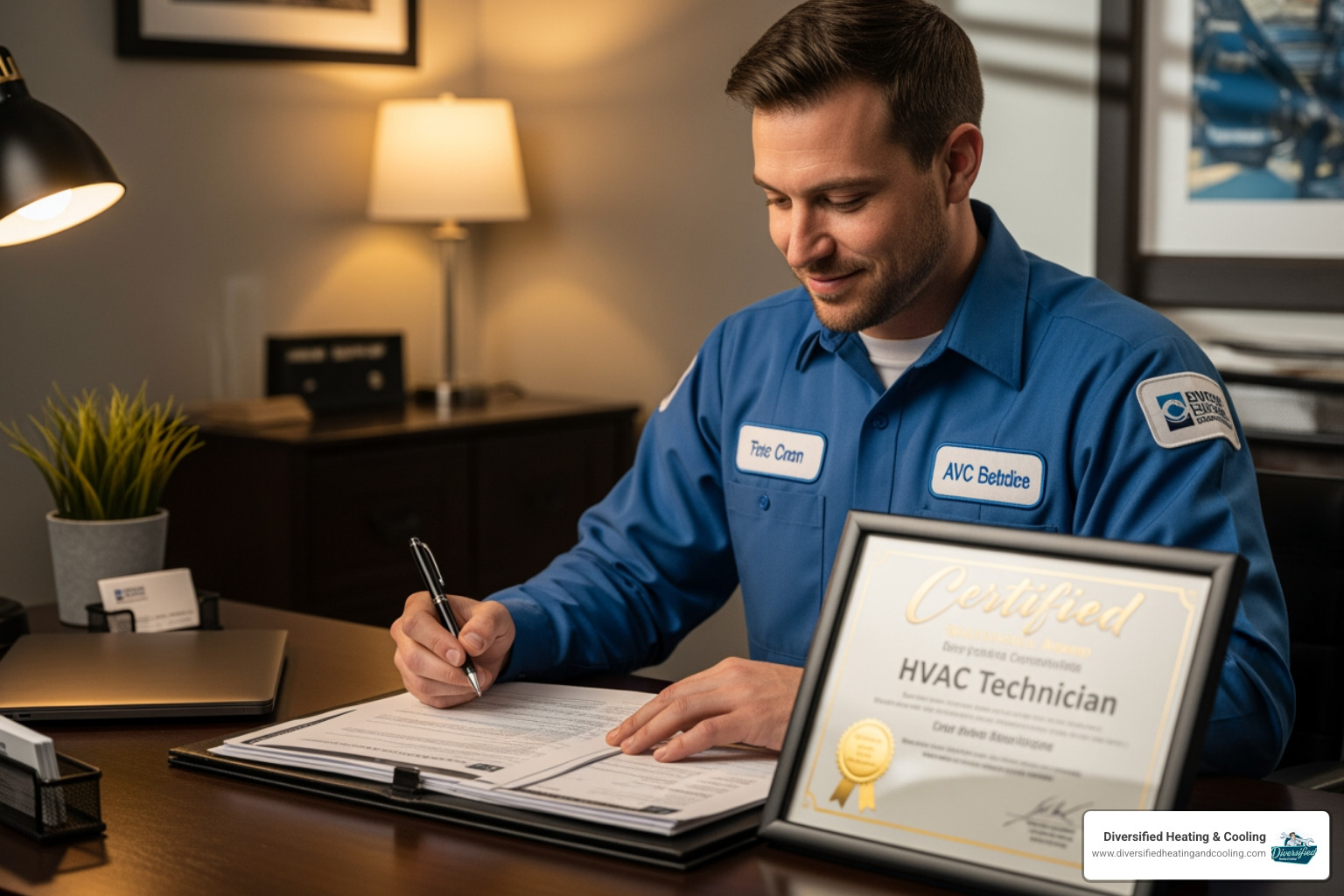
The California Contractors State License Board (CSLB) has been protecting homeowners like you since 1929. They’re the gatekeepers who make sure contractors meet strict standards before they can legally work on your heating system. This isn’t just bureaucratic red tape—it’s your shield against shoddy work and fly-by-night operators.
Here’s what a legitimate heating contractor must have to work legally in California: They need a C-20 classification specifically for heating, ventilating, and air conditioning work. This isn’t a general handyman license. It’s specialized proof that they understand the complexities of HVAC systems.
Getting that C-20 license isn’t easy. Contractors must show at least four years of hands-on, journey-level experience in the trade. Then they have to pass two separate exams—one covering California law and business practices, and another testing their technical knowledge of heating and cooling systems. It weeds out anyone who isn’t serious about the profession.
Every licensed contractor also carries a contractor’s bond, typically ranging from $15,000 to $25,000. Think of this as a financial safety net. If a contractor abandons your project or fails to meet their obligations, that bond provides you with recourse to recover your losses.
Workers’ compensation insurance is another requirement if the contractor has employees. This protects you from liability if someone gets hurt while working on your property. It’s one of those things you hope you’ll never need, but you’ll be grateful it’s there if something goes wrong.
So why does all this matter when you’re just trying to get your heater fixed? Because the difference between a licensed and unlicensed contractor is night and day.
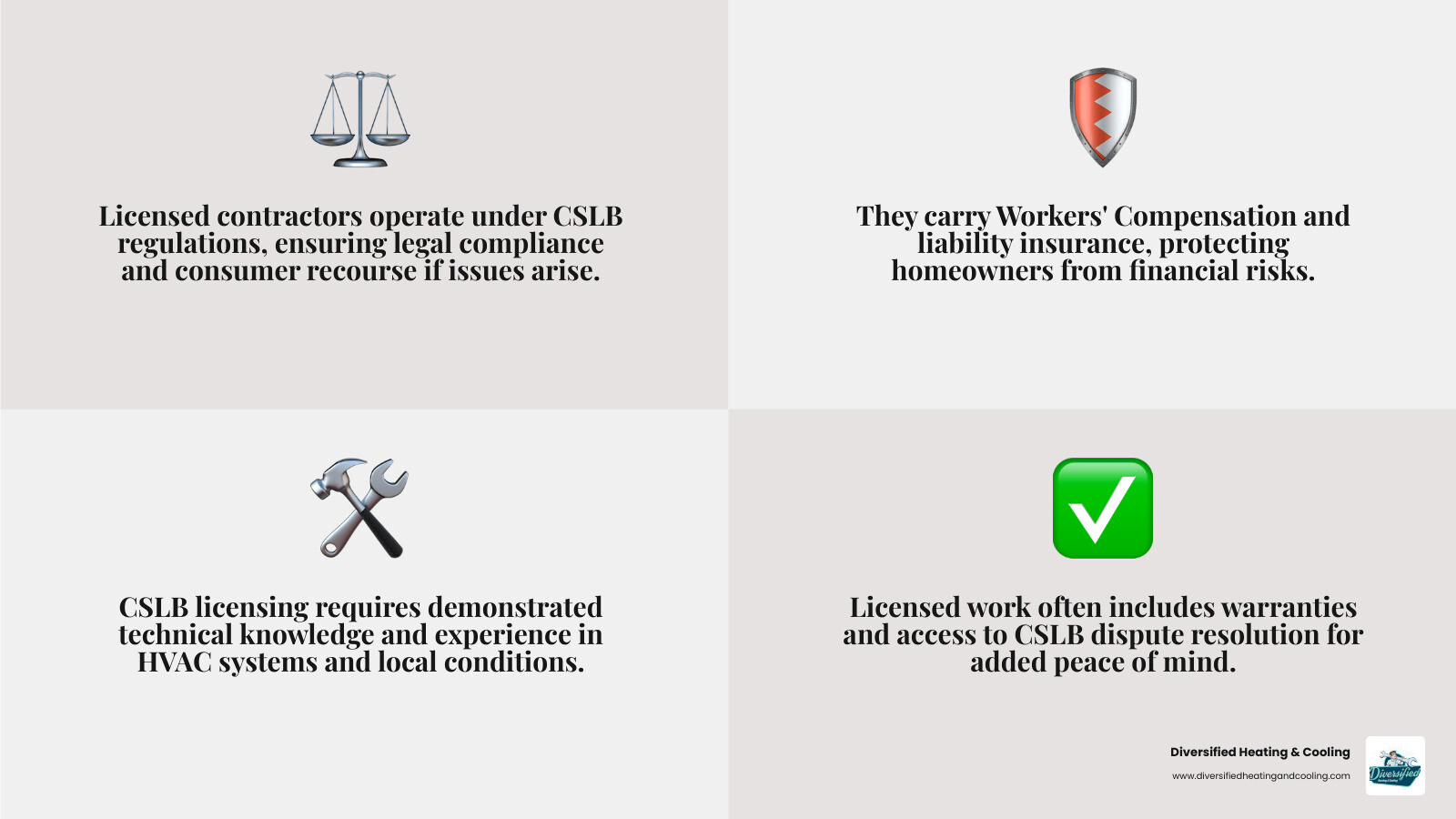
A licensed contractor answers to the CSLB. If something goes wrong, you have an official path to file complaints and seek resolution. An unlicensed person? They’re operating in the shadows, and you have virtually no recourse if they do poor work or disappear with your money.
Licensed contractors carry liability insurance that protects your property. They understand local building codes and make sure your heating system meets safety standards. They offer warranties on their work. They’ve proven their expertise through years of experience and rigorous testing.
Unlicensed contractors offer none of these protections. They might quote you a lower price upfront, but that “savings” can cost you dearly when their work fails, violates codes, or creates safety hazards. You could end up paying twice—once for the bad work, and again to have a real professional fix it properly.
The CSLB makes it easy to verify any contractor’s credentials. We encourage you to use their resources every single time you hire someone for home improvement work. Your heating system is too important to gamble on. For complete consumer protection information and to check a contractor’s license status, visit the CSLB consumer resources page.
When winter nights drop below freezing in Joshua Tree, you want to know the person who installed or repaired your heating system did it right. That peace of mind is what licensing provides.
How to Find and Vet a Licensed Heating Contractor in Joshua Tree, CA
Finding the right licensed heating contractor in Joshua Tree CA doesn’t have to be overwhelming. With a few smart steps, you can confidently choose a professional to keep your home comfortable through cold desert nights.
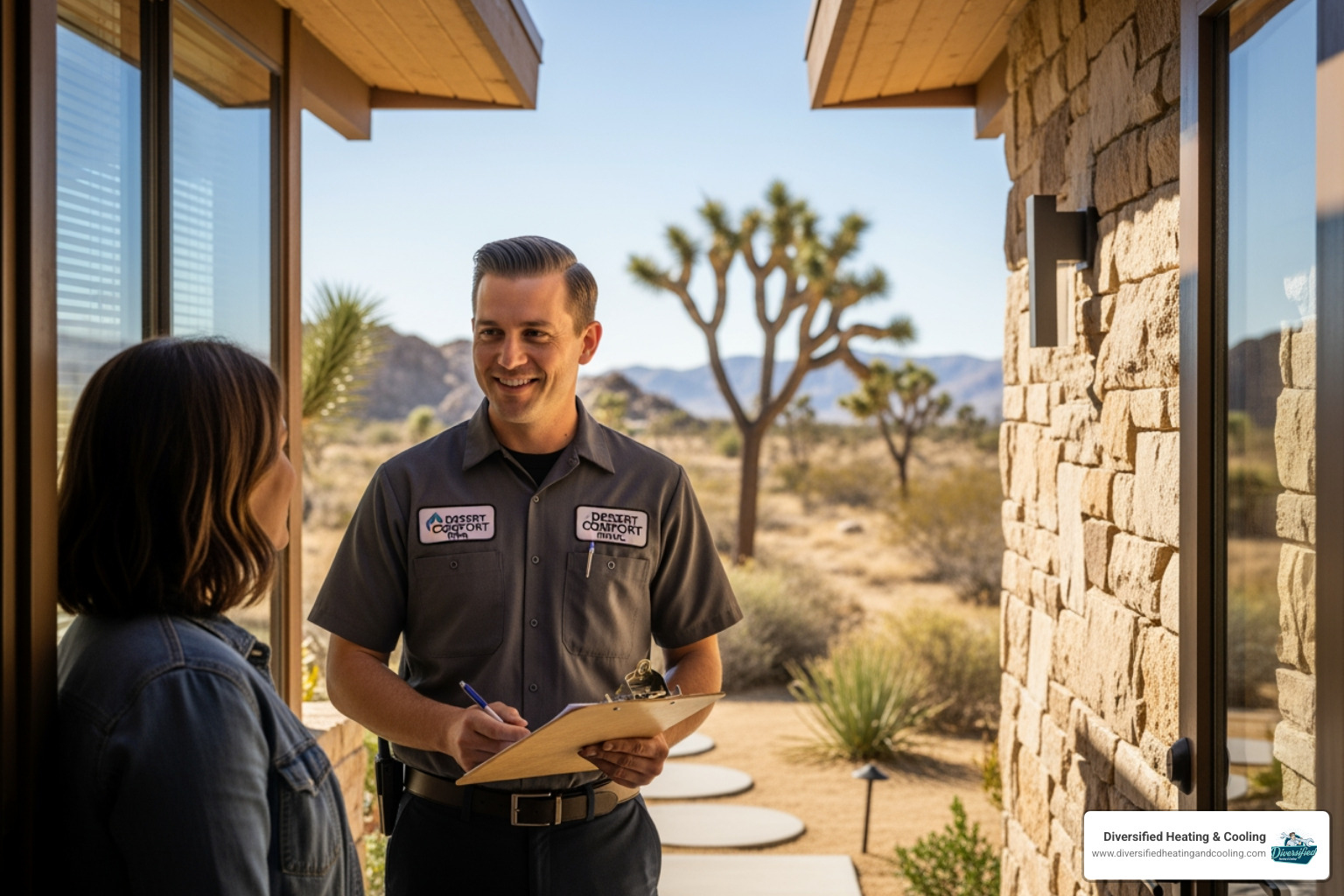
Start with recommendations from neighbors and friends in the Morongo Basin. Beyond word-of-mouth, you can search online directories or use the CSLB’s “Find My Licensed Contractor” tool to locate professionals in your area.
Once you have a few potential contractors, visit their websites. A reputable company will clearly display their services and contact information. Longevity in the community is a good sign of reliability. Our commitment to the Morongo Basin since 2009 speaks to our dedication. You can learn more about professional HVAC contractors in Twentynine Palms, CA and what to expect from local service providers.
Next comes the most important part: vetting your choices. Your best tool is the CSLB License Check. Go to the CSLB website and use their “Check a License” tool. Enter the contractor’s license number to see if their license is active, if they hold the proper C-20 classification for HVAC work, and details about their bond and workers’ compensation insurance. This step is non-negotiable.
Beyond the license check, ask the contractor for a certificate of insurance. This proves they have liability insurance (to protect your property) and workers’ compensation insurance (to cover employee injuries). A legitimate contractor will provide this without hesitation.
References offer a window into a contractor’s real-world performance. Ask for contact information from recent clients in Joshua Tree or nearby towns. When you call, ask about the quality of work, timeliness, how they handled unexpected issues, and if they’d hire them again.
Online reviews on platforms like Google and Yelp also provide valuable insights. Look for patterns rather than focusing on a single review. Consistent praise for professionalism is a great sign, while repeated complaints about communication or workmanship are red flags. Our customer testimonials often highlight our honesty and reliability—values we’ve built our business on.
Key Questions to Ask a Potential Heating Contractor in Joshua Tree, CA Before Hiring Them
Asking the right questions upfront helps you separate the professionals from the pretenders. When interviewing a potential licensed heating contractor in Joshua Tree CA, be sure to ask the following.
Start with the basics: “Can you provide your CSLB license number and proof of insurance?” If they hesitate or make excuses, move on.
Experience in our climate is crucial. Ask, “How long have you been serving the Joshua Tree and Morongo Basin area?” A contractor who has worked in this environment for years understands the unique challenges of desert conditions, like temperature swings and dust infiltration.
Get clarity on protection: “What warranties do you offer on your work and the equipment you install?” Reputable contractors stand behind their work. Understanding what’s covered gives you peace of mind.
Before any work begins, ask for a detailed, written estimate that includes all costs. This transparency prevents surprise bills. Also, be aware that California law limits upfront payments for home improvement projects to $1,000 or 10% of the contract value, whichever is less.
Communication is key, so ask about the estimated project timeline and how they’ll keep you updated. Knowing when work will start and finish helps you plan accordingly.
Find out who will actually be doing the work. Are they employees or subcontractors? Have they been background-checked? You’re letting people into your home, so these questions are important. Our team consists of trained, certified technicians we trust completely.
Finally, ask about emergency services. Heating systems don’t always fail at convenient times. Knowing if your contractor offers 24/7 support provides peace of mind during freezing desert nights.
Certifications and Specializations to Look For
While a CSLB license is the baseline, additional certifications indicate a contractor’s commitment to excellence.
NATE certification is the gold standard in our industry. North American Technician Excellence is a voluntary certification demonstrating real-world knowledge of HVAC systems. NATE-certified technicians have passed rigorous exams testing their practical skills.
Brand-specific training is another valuable specialization. Manufacturers offer specialized training for contractors who service their equipment. These certifications mean the technician has in-depth knowledge of that brand, leading to better installations and repairs.
Ductless system expertise is increasingly important for mini-split systems, which are perfect for homes without existing ductwork or for zoned heating. If you’re considering this option, look for contractors who specialize in ductless technology.
With desert dust and allergens, indoor air quality specialization is also worth considering. Some contractors offer advanced solutions like whole-home air purifiers and high-efficiency filtration systems.
These additional credentials show a contractor invests in continuous learning, which reflects in their work quality. You can learn more about our commitment to professional service on our About Us page.
Common Heating Services and Issues in the High Desert
Life in Joshua Tree means incredible scenery and serious temperature swings. When winter hits, you need a heating system that works reliably. That’s where a licensed heating contractor in Joshua Tree CA becomes your most valuable partner.
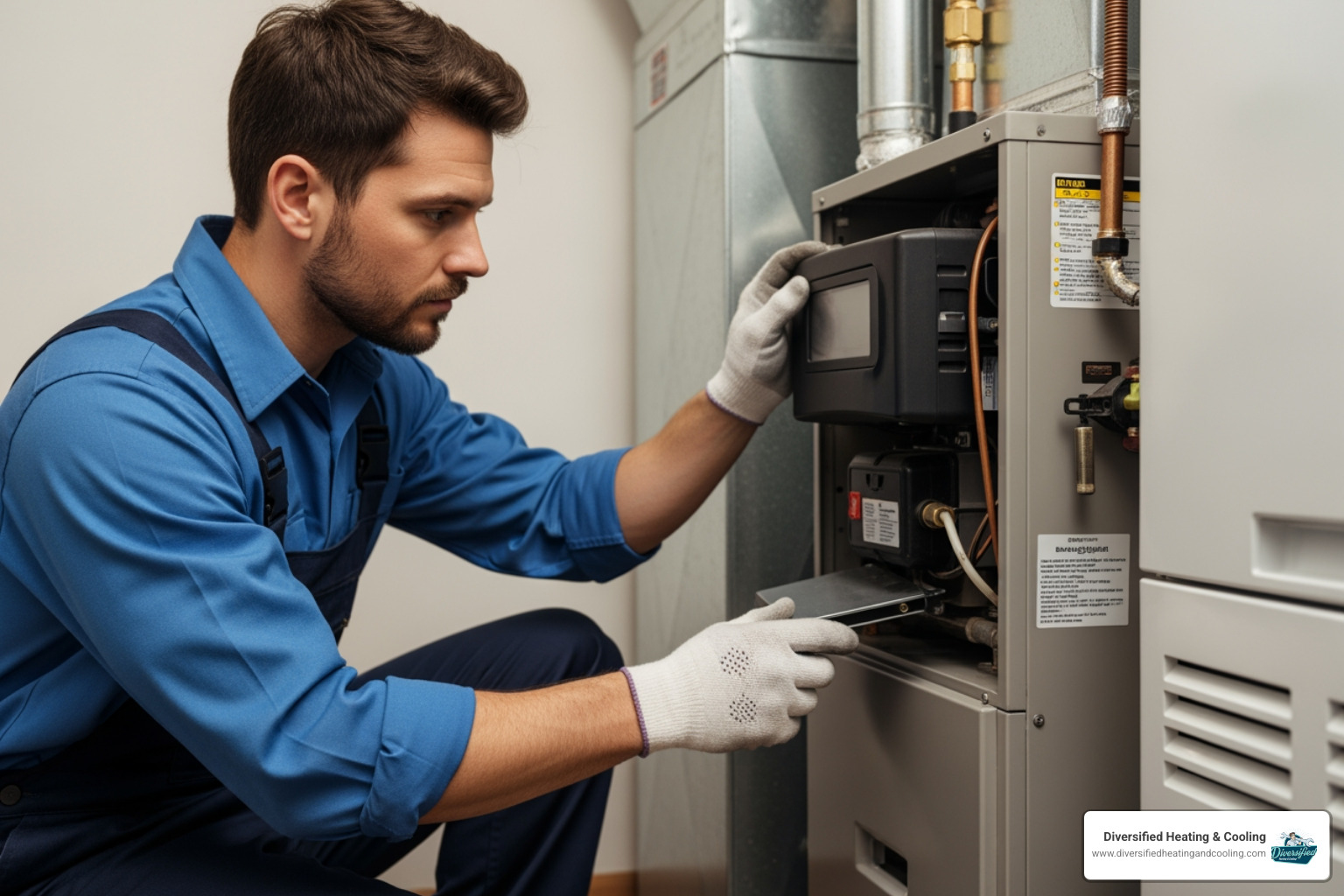
The high desert environment creates specific demands on your heating equipment. Dust infiltrates everything, and systems that sit idle most of the year need to spring into action when you need them most. A qualified contractor understands these challenges and provides services custom to our unique conditions.
Heating system repair is often the most urgent service homeowners need. When your furnace stops working on a freezing night, you can’t afford to wait. A licensed professional can quickly diagnose the problem and get your home warm again. Our team has been providing heating and furnace repair in Yucca Valley, CA and throughout the Morongo Basin since 2009, so we’ve seen just about every heating issue this climate can cause.
Furnace installation requires expertise and precision. An improperly sized or installed furnace wastes energy, creates uneven heating, and can wear out prematurely. When replacing an aging unit or installing a new system, a licensed contractor ensures everything is done right. You can learn more about our approach to heating installation in Yucca Valley, CA.
Routine maintenance is the secret to avoiding emergency breakdowns. An annual tune-up catches small problems before they become expensive disasters. Your technician will clean components, check for wear, test safety controls, and replace filters. In our dusty environment, this regular attention makes all the difference in system longevity and efficiency.
Heat pumps offer an energy-efficient solution for desert living because they both heat and cool your home. These systems work by moving heat rather than generating it, which can significantly reduce energy use. A licensed contractor can help you determine if a heat pump is right for your home.
Ductless mini-split systems are popular in the high desert, especially for homes without existing ductwork or for adding comfort to specific areas. These systems offer zone control, allowing you to heat different areas to different temperatures. They’re efficient and quiet when installed by a knowledgeable professional.
Ductwork services are often overlooked, but your ducts are the circulatory system of your heating setup. Leaky or poorly insulated ducts waste energy and create uncomfortable temperature variations. A professional can design, install, seal, and repair ductwork to ensure heated air reaches the rooms where you need it.
What Common Heating Issues Can a Licensed Heating Contractor in Joshua Tree, CA Address?
We’ve diagnosed and fixed countless heating problems in the Morongo Basin. Some issues are minor, while others require immediate professional attention. Here’s what a licensed heating contractor in Joshua Tree CA regularly encounters.
Thermostat malfunctions can make you think your furnace is broken when it’s just the control center. It could be dead batteries, or the thermostat itself may need replacement. A professional can also properly integrate modern smart thermostats with your system.
Pilot light or ignition problems are common with gas furnaces. If your pilot light won’t stay lit or your electronic ignition won’t spark, you won’t get any heat. These issues involve gas and electrical components, so they are not DIY projects. A licensed technician has the training to handle these repairs safely.
Frequent cycling—when your furnace turns on and off in short bursts—is inefficient. This can be caused by an oversized unit, a clogged filter, or a faulty thermostat. It increases wear on components and drives up energy bills. A professional can identify and fix the root cause.
Strange noises are your heating system’s way of telling you something is wrong. Grinding might indicate a failing motor bearing, while squealing often points to a worn belt. Banging could mean loose parts. Ignoring these sounds can lead to bigger, more expensive problems.
Uneven heating leaves some rooms toasty while others are cold. This can stem from ductwork problems, inadequate insulation, closed vents, or an improperly sized system. A licensed contractor can pinpoint the cause and recommend solutions.
Clogged filters from desert dust are a given in our environment. While you should change filters every 1-3 months, dust also accumulates on internal components. During routine maintenance, technicians clean these parts and check for dust-related damage. For comprehensive care, explore our furnace repair services in Yucca Valley, CA.
No heat or insufficient heat is the nightmare scenario on a cold night. This could be caused by anything from a tripped circuit breaker to a major component breakdown. These situations require immediate professional diagnosis and repair. DIY repairs can be dangerous and may void warranties.
Frequently Asked Questions About Local Heating Services
We’ve been serving Joshua Tree, Yucca Valley, and Twentynine Palms for years, and certain questions come up again and again. Here are the answers to what we hear most often from homeowners like you.
What is the difference between a license and a certification?
Great question—and it’s one that trips up a lot of people! While both sound similar, they serve very different purposes when you’re looking for a licensed heating contractor in Joshua Tree CA.
A license is a legal requirement. It’s issued by the California Contractors State License Board (CSLB) and means the contractor has met strict state standards for experience, knowledge, and financial responsibility. Think of it as your baseline protection. Without that C-20 classification license, a contractor isn’t legally allowed to work on your heating system. Period. If they’re operating without one, you have virtually no recourse if something goes wrong.
Certification, on the other hand, is voluntary. Programs like NATE (North American Technician Excellence) certification test a technician’s real-world skills and knowledge in specific areas of HVAC work. It’s not legally required, but it shows a commitment to excellence and ongoing education. A NATE-certified technician has proven they know their stuff beyond just meeting minimum legal requirements.
Here’s a simple way to think about it: a license is like a driver’s license—you need it to operate legally. Certification is like taking an advanced driving course—it’s optional, but it shows you’re serious about doing things right.
How often should my heating system be serviced?
We recommend having your heating system professionally serviced at least once a year, ideally in the fall before you really need it. Living in the high desert, you know how fast things can get dusty and worn down. Your furnace or heat pump is no exception.
Annual maintenance does more than just check a box. It improves your system’s efficiency, which can lower your energy bills—something we all appreciate. It extends the lifespan of your equipment, helping you get the most out of your investment. Most importantly, it prevents breakdowns by catching small issues before they turn into expensive emergencies on the coldest night of the year.
For gas furnaces especially, yearly inspections are crucial for safety. A trained technician will check for carbon monoxide leaks and make sure all components are operating as they should. We’ve seen too many situations where a simple annual tune-up would have prevented a major headache.
Think of it like getting your car serviced. You wouldn’t skip oil changes and expect your vehicle to run perfectly, right? Your heating system deserves the same attention.
What should I do if I have a dispute with a licensed contractor?
Nobody wants to end up in a dispute, but sometimes things don’t go as planned. If you’re having an issue with a licensed heating contractor in Joshua Tree CA, here’s what we recommend.
Start by talking directly with the contractor. Most issues stem from miscommunication or misunderstandings. Reach out calmly and clearly explain your concerns. Put it in writing—an email or letter works best—and outline what the problem is and what you think would be a fair solution. Many contractors, including us, genuinely want to make things right and will work with you to resolve the situation.
Document everything. Keep copies of your contract, all invoices, emails, text messages, photos of the work, and notes from phone conversations. If the situation escalates, this documentation becomes incredibly valuable. Write down dates, times, and what was discussed. The more thorough you are, the better.
Contact the CSLB if direct communication doesn’t work. The Contractors State License Board exists to protect consumers like you. You can file a formal complaint with them, and they have a structured process for mediating disputes. They can investigate claims of poor workmanship, contract violations, or other issues. They can even take disciplinary action against contractors who break state laws. This is one of the biggest advantages of hiring a licensed professional—you have a powerful advocate in your corner.
The CSLB is there for you. While we always aim for complete customer satisfaction and work hard to resolve any concerns directly, it’s reassuring to know that safety net exists when you choose a licensed contractor.
Your Partner for Reliable Heating in Joshua Tree
When high desert temperatures drop and those freezing nights settle in, you need to know your heating system is in capable hands. Finding a qualified licensed heating contractor in Joshua Tree CA isn’t just about staying warm—it’s about protecting your home, your investment, and your family’s comfort.
Throughout this guide, we’ve covered the essentials: understanding what California’s C-20 licensing really means, using the CSLB’s tools to verify credentials, asking the right questions before signing any contract, and recognizing the unique heating challenges that come with living in Joshua Tree, Yucca Valley, and Twentynine Palms. These aren’t just bureaucratic hoops to jump through. They’re your safeguards against substandard work, safety hazards, and the frustration of dealing with unlicensed operators who vanish when problems arise.
The effort you invest in choosing a licensed and properly insured professional pays dividends in peace of mind. You’ll know your furnace installation meets code, your repairs are done right the first time, and if anything goes wrong, you have real recourse through the CSLB. That’s the difference between crossing your fingers and sleeping soundly.
At Diversified Heating & Cooling, we’ve made it our mission to be the heating partner our neighbors can count on. Since 2009, we’ve been serving families throughout the Morongo Basin with honest, reliable service. We’re not just technicians—we’re your neighbors who understand what it means to face a cold desert night with a broken furnace. Our family-oriented approach means we treat your home with the same care we’d give our own.
We believe in doing things the right way: proper licensing, ongoing training, transparent communication, and standing behind every job we complete. Whether you need routine maintenance before winter hits, an emergency repair, or a complete system replacement, our licensed team brings the expertise and integrity you deserve.
Don’t wait until the next cold snap to find your heating system needs attention. Take control of your home comfort now by partnering with professionals who’ve earned their reputation one satisfied customer at a time.
Ready to experience the difference a truly reliable heating partner makes? Contact us to schedule a heating service appointment and let our licensed experts bring warmth and comfort back into your home.